
Why Theology Is More Important Than Ever in a Twisted-Truth World
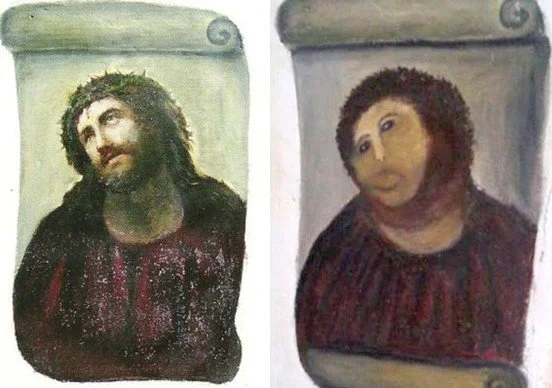
The original version and the restored version of “Ecce Homo”
About a decade ago, there was an international news story about a fresco (a painting done in water-based pigment on wet plaster on a wall) of Jesus called “Ecce Homo” (“Behold the Man”). Due to its age, the fresco was getting to a point where it needed restoration. A local woman named Cecilia took on the job to restore it back to its original look. Unfortunately, she was an amateur painter and despite her best efforts, turned Jesus into a very unusual and strange looking Jesus.
The oddness of the new Jesus (some called it a “monkey Jesus”) made worldwide news. Today, this fresco has become a major tourist attraction in this small church in Spain where people now can go see this strange looking version of Jesus.
For those who knew the what the original Jesus fresco looked like, it was obvious that the restored version was nothing like the original. However, what if you had never seen the original fresco? While you might wonder why Jesus doesn’t look like a normal person, you wouldn’t know that it had been changed because you weren’t familiar with the original.
The more information and teaching out there, the more we need theology
Now, in the case of the fresco, that was an artistic rendering of Jesus that someone altered. No major harm done, except for the awkwardness of altering a church fresco. And everyone knew that the new one wasn’t the real Jesus. However, today there is harm being done by all types of new Jesuses being argued for that many people don’t realize are nothing like the original and true Jesus. On TikTok and other social media platforms, we are seeing all types of influencers teaching about Jesus and Christian beliefs. Many of them are super helpful, biblically based, and faithful to the truth. I love learning from them. But at the same time, there has emerged a flood of influencers painting new types of Jesuses that are not in alignment with the Scriptures and historic Christian beliefs. Sadly, many don’t realize they aren’t true.
There is a rise of former pastors and church leaders building platforms of influence. Some use the term “exvangelicals” for themselves while maintaining their faith in “Jesus.” Some are building platforms based on often disturbing and sad stories of what they experienced in churches they were part of. Others online who are vocal and teaching about Bible and Christian beliefs are ones who have left the faith entirely and are now atheist or agnostic. Amongst all of them, there is a general “I bet you were never told this about Jesus or the Bible” type of approach. So, it is intriguing of course. These teachings are usually done with matter-of-fact confidence, often using a Greek word or two, and saying these new truths have been kept hidden from Christians or ignored.
Some of the common types of teachings we see online are stressing how it was Paul, not Jesus, who shaped Christianity and the church as we know it. So, rather than listening to Paul we are encouraged to just focus on the red-letter words of Jesus in the New Testament. Some of the teachings online make a case that the cross was violent, and God would not have used violence. So, Jesus died as a martyr fighting against the oppressors and standing up for the marginalized, but not for the payment of our sin. We are told that God would never use violence, so the Bible must be then wrong where we see stories of violence in the Old Testament. And if the Old Testament is not inspired by God’s Spirit and true, then if follows that perhaps not all of the New Testament is 100% inspired. If you are paying attention, you will see these types of arguments are increasingly appearing on social media. The reality is that they are creating a repainting of Jesus and key doctrines which are not in alignment with historic Christian orthodoxy.
If the Scriptures are true, then we can welcome any challenges to them
This may sound contradictory, but I actually appreciate these new influencers. If we have nothing to fear or hide about historical Christian beliefs, then these challenges can be exercises in how well we know our Bible and theology. I have watched literally hundreds of these videos and I can say with humility that the majority of them can be easily shown to be incorrect. Many of these influencers often use the classical strategy of taking some Old Testament verses from the Levitical laws out of context and then accusing Christians of cherry-picking what we want to believe from these and ignoring the others. But those who quote verses from the Old Testament Law to prove Christians are hypocritical don’t understand the biblical storyline or how Jesus comes to fulfill the Law and the Prophets. As easy as it is to see through these arguments not being biblically valid, so many Christians who haven’t studied biblical theology or hermeneutics get misled into thinking these teachings have validity.
Subtly twisted truths end up creating entirely different types of Jesus
This is why in today’s world, sound theological thinking becomes so urgently and critically important. The more information online we now have about Jesus, the Bible, and doctrine, the more we need to be thinking theologically. We need the ability to discern what is correct and what isn’t. In former days we could say “Jesus” and generally it would be understood to be the Jesus of the entire Bible. But today we say “Jesus” and we have so many Jesuses being talked about that often are quite contradictory when you compare them. When the fresco of Jesus in that chapel in Spain made the news, Time Magazine started a contest to “create your own Jesus fresco.” People submitted revised paintings of “Jesus” that included Batman Jesus in a hood and cape, a hippy Jesus holding flowers, etc. It was a free-for-all sort of create-your-own-version of Jesus. In some ways the same thing is happening today, but more subtly. I often read comments from people who watch what the new influencers are posting and see comments like “This is awesome!” or “This is the Jesus I love,” etc.
Interestingly, these new versions of Jesus and Christian beliefs are quite popular because they often align with cultural norms of our day. They remove the conflict that can result from holding to historic beliefs and ethics. They offer the comfort of not being labelled and seen as hateful because you hold to historical Christian doctrines and ethics. A major celebrity recently endorsing some extremely false interpretations of the Bible stated that “Jesus was about love, not hate”. Who wants to be known as hateful? So, we see that what love is now being defined by cultural understandings of love, not biblical definitions. All of this makes it quite tempting for some believers who don’t understand theology and Bible study methods to then adopt a new set of beliefs and still feel they are following Jesus.
Theology must be at the forefront of our minds and hearts in our churches today
All of this confusion is exactly at the heart of why I ended up coming on staff at Western Seminary. I have been the primary leader at Vintage Faith Church in Santa Cruz, Calif. since we planted the church in 2004. But the need for training younger leaders who in turn will train new generations is so urgent that I wanted to join up with the mission of Western. I think we had the luxury in the past of assuming most people understood the core historical doctrines of faith, but today that’s no longer a reality, even amongst Christians. It is wonderful to see the trend and resurgence of younger generations gathering to sing songs of praise and worship. But we need to make sure they also are getting grounded in theology and biblical doctrines so that they won’t be caught off-guard by the wave of confusing teachings confronting them.
Here are some principles I like to use for thinking through and letting others know how to discern whether online teaching (or any teaching) is to be trusted or not:
What is their view of Scripture?
The most important question that shapes everything is what someone believes about Scripture. Does the person hold to 100% of every original word being exactly what God wanted (the theological term used for this is inerrancy)? If they don’t, then almost anything goes. A commitment to the authority of Scripture is foundational.
What education do they have to qualify their opinions? What are the sources for what they are teaching?
I find that most of those TikTok influencers teaching new and incorrect versions of Jesus do not have theological training. They repeat things they read or see on other social media outlets. I try to always look up people or even contact them to ask if they had any theological training, where they got their information from, or what sources they are using.
Are they taking verses out of context or isolating them from the storyline of Scripture?
So many times, I see a very poor understanding of Scripture on social media, without any reference to respected theologians who do systematic or biblical theology. I always check what I hear with trusted scholars and commentaries.Are they part of a church? If so, how does that church’s beliefs reveal their theological positions?
Anyone familiar with the New Testament knows how important it is for Jesus followers to be part of a local church. So, with influencers, I take the effort to research to see if they are part of one. If not, that is not a good sign. But if they are, I see if their church holds to the historical doctrines of faith and sees the Bible as 100% inspired and trustworthy. What local church one chooses to be part of is a major indication of one’s theological beliefs.
Despite these challenges, I am excited about what God is doing among younger generations
Even though this is a challenging time, I have heard so many positive stories of churches whose leaders are allowing for opportunities for younger generations to ask honest questions. One leader had his youth group do a series on examining TikTok videos to see if they were theologically sound. Training new generations how to be thinking theologically is a major part of a church leader’s role today. I am thrilled to be part of Western as we provide training in Bible and theology for a new generation of leaders. If you aren’t yet trained, or know someone who isn’t, come and join us in the mission to learn theological thinking to impact and help those who are getting sadly “tossed by the waves and blown around by every wind of teaching.”